
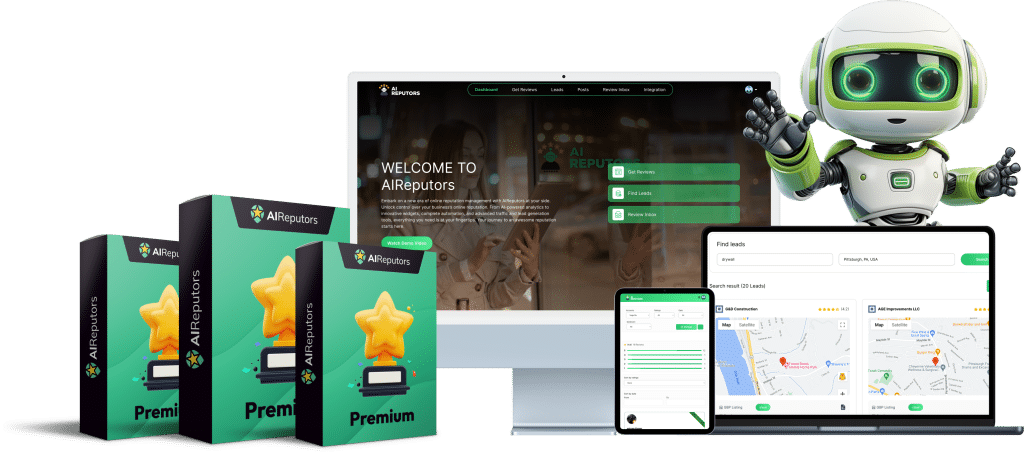
>> Bundel Deal Edition <<
Get all AIReputors OTO links to the direct sales pages. With the big discount and three hot bonus packages, with AIReputors OTO hot bonuses packages value $40k, fasten your seatbelts and get ready to embark on a journey into the world of automation and its transformative effects on various industries. see all the AIReputors OTO sales pages below, with all the information for each OTOs.
AIReputors OTO
Note: We recommend getting the bundle deal edition “FE + All Upgrades version” and save $315
==> Use this coupon to save $50 ” AIREPUTORS “
>> Bundel Deal Edition <<
>> Front-End <<
>> OTO1 ‘Fast Pass’ Edition <<
>> OTO2 Unlimited Edition <<
>> OTO3 Platinum Edition <<
>> OTO4 Enterprise Edition <<
>> OTO5 RankReel Special Edition <<
>> OTO6 Koincart Special Edition <<
>> OTO7 ClickagencyAI Special Edition <<
Your Free Hot Bonuses Packages
>> Reseller Bonuses Packages 1<<
>> Reseller Bonuses Package 2 <<
>> Hot Bonuses Package 3<<
>> Hot Bonuses Package 4 <<
In today’s rapidly changing world, automation technology is one of the major factors that make the world a better place to live in as it is redefining the whole notion of modern industry. The concept of automation is being applied in various sectors simultaneously so, we can finally say that the future of automation is here. Without a doubt, the most impact has been seen in the manufacturing industry and logistics, as they could achieve far better results than their previous human-dependent operations. Not surprisingly, other major fields have not been left out and the revolution is felt in the healthcare and financial services industries, where automation has come to stay and is now an integral part of every system. At the same time, automation introduction may not only cause cost efficiency but also the socially fair income distribution and workspaces’ creation. Automation technology, thus, not only swi…
AIReputors OTO – Manufacturing Industry
Enhanced Productivity and Sustainability
Automation technology has completely transformed the manufacturing industry, which has, in turn, led to enhanced efficiency and productivity. The introduction of automated systems and processes among the manufacturers paves the way for the smooth operation and the reduction of production time. Automated production floors and robots are capable of executing tasks much more quickly and accurately than manual workers do, thus industrial productivity is determined to grow. Companies are able to meet customer needs more efficiently and quickly with automation, thereby realizing a more competitive position in the market.
Reduced need for labor
Labor Cost Reduction is a primary benefit of automation technology in the manufacturing industry. By installing machines and robots instead of human labor, companies can greatly reduce or even eliminate their dependence on human workers. Automated systems can perform simple, repetitive, and mind-numbing tasks on their own without the need for a human workforce, thereby reducing the labor force and labor expenses. Manufacturers can then reallocate their resources to other parts of their business and invest in, say, research, and quality improvements.
Improved Equipment and Safety Protection
Automation technology also played an important role in revolutionizing the safety aspect of the industrial sector. The use of machines in environmentally challenging and risky tasks to a great extent has replaced manual labor, the result being a reduction in work-related accidents and injuries. Subsequently, automated systems, instead of the human workforce, can take up the responsibility of carrying out jobs involving poisonous gases, extreme temperatures, or huge machines thus keeping the staff safe and sound. Future regulations and the enactment of automated safety can be the major forces that will ultimately eliminate accidents in the workplace, and this is why safety is an essential element of the whole controlled process.
Increased Precision and Accuracy
Automation technology is the biggest driver for the manufacturing sector since intelligent machineries have the ability to reach the highest peak of precision and accuracy a human being could only dream of. As a result of this high level of precision, the probability of the appearance of a mistake made by humans as in the case of manual labor is minimal. Especially in industries that demand precision, like the manufacturing of electronic components or medical devices, it is hard to overestimate the significance of the technology of automation. Automation technology not only supports businesses in delivering high quality products that follow the most stringent standards and meet customer expectations through their consistent quality but also by making sure that the measurements are carried out with the maximum possible precision.
Better Quality Control
Automation systems are at the center of quality control issues for the manufacturing sector as they are instrumental in the establishment and maintenance of quality control mechanisms. Automated systems can carry out more advanced quality checks to ensure that products are free from even the tiniest tiny defects or that the set parameters are not deviated from. Implementing automated methods for inspection and testing, manufacturers can catch and solve quality problems at an early stage, keeping the defective products off the market. This not only enhances the products’ reputation but also boosts customer satisfaction and lowers the possibility of having to recall or return the already sold items.
AIReputors OTO – Transportation and Logistics Industry
Automated Vehicles and Drones
The technology of automation contributing greatly to many industries has revolutionized the transportation and logistics Industry through the introduction of automated vehicles and drones. The emergence of self-driving vehicles like cars and trucks has not only reduced the dependence on human drivers for product delivery but also made the transportation process more efficient. Moreover, drones are finding applicability in the logistics area for example they were employed in the last stage of delivery and to oversee stocks. This automated technology of vehicles and drones facilitates faster and safer transfer of goods while the error made by human beings is greatly reduced.
Efficient Supply Chain Management
A supply chain significantly benefits from the machines that transport and distribute items, as well as modern technology, in the eCommerce sector. Already, companies can operate their supply chains in the best way possible by the use of smarter software systems, thus cutting down their costs and, at the same time, increasing their efficiency. Do the automated systems assist the companies in tracking the inventory level live so the they will be able to carry out the inventory more accurately and stay away from situations where the supply is over or too low? Furthermore, automation permits the adjustment to be made and the communication between the members of the chain to become more straightforward and easier, since it reduces in-between operations time and gives rise to on-time delivery of commodities.
Enhanced Tracking and Monitoring Systems
The logistics and transportation industry has experienced a huge change using automation in tracking and monitoring systems especially with the introduction of technology. Real-time GPS and sensor technologies are the ones that have seen an end to the age of darkness and opened the door of light for the transportation and logistics industry, a change advocated and strived for by the industry’s professionals. Consequently, the use of those technologies, the most prominent ones being GPS and sensors, has increased the ability of the transportation and logistics industry and its stakeholders to locate and monitor the real-time condition of their vehicles and cargo. With live tracking, companies have enhanced visibility and control over their business processes and have thus become more efficient and less vulnerable to the loss of billions of dollars due to theft or loss of goods.
Improved Delivery Speed
Through automation technology, there has been a considerable improvement in the speed of delivery in the transportation and logistics sector. Fast delivery is now guaranteed since automated systems are used to simplify the delivery process, thus reducing the time of the entire supply chain. To cite an instance, when there are automatic sorting and loading systems in place in the warehouse, it ensures the least loading time, thus helping in reducing the delivery time and in the end increasing the overall speed of the delivery process. The most popular use of automated vehicles and drones for delivery is the fastest and the most direct delivery. Unnecessary calls are avoided. Their fast and direct routes make almost half of the transit time.
Eliminate Mistakes Made by People
Automation has been a major driver in the transportation and logistics industry allowing the curbing of human-related errors. the manual operations are being handled by automated systems a substantial reduction in the number of errors that can be caused by human factors such as tiredness or distraction is ensured. Automated systems can execute jobs more accurately and uniformly, thus, reducing the chances of errors in order processing, inventory management, or shipment tracking. This highly benefits the customers as they are able to receive goods of the right quality and faster, and this action automatically leads to an increase in customer satisfaction and the company’s income through reduction of errors or rework costs.
AIReputors OTO – Healthcare Industry
Automation in the Discipline of Medicine: Robotic Surgery and Assistive Devices
In the area of the healthcare industry where the majority of changes occurred, automation was the ringleader. The robotic technology is not invasive and is precise and simple that it reduces the rate of possible surgical complications and it can even cure patient! Thus, these appliances not only of… as the surgeon can carry out a surgery of high complexity with more accuracy and less damage, which results in shorter recovery times and fewer hospital stays. Thus, ongoing assistance of the healthcare industry initiated by new automation leads to the creation of fully… Moreover, the accomplishment of admin tasks through automation not only reduces costs but also saves the time of healthcare heroes and patients. Although… the only limitation in this area are a tight schedule that makes finding opportunities for automation challenging, while the other departments have open doors for implementation.
Automation of Administrative Tasks
New technology has also sped up the execution of administrative duties in the hospital field, enabling the staff to perform their tasks faster and better. Computerized solutions can manage tasks such as appointment scheduling, patient registration, and billing, eliminating the necessity of manual data entry and hence occurrences of errors. This ensures that healthcare staff devote a larger part of their time to serving their patients while most of the routine tasks are automated. In addition, one can see that automation technology promotes the information sharing process between different clinics which obviously…
Streamlined Patient Monitoring and Care
Automation technology has very significantly magnified the patient monitoring and care in the healthcare industry. Automated monitoring systems are able to continuously monitor vital signs and inform medical staff of any deviation or change in a patient’s health status. The above not only allows for early incipient changes to be detected in a person’s health condition but it is also instrumental in expeditious and successful interventions which are essential to cure terminally ill patients and thereby the incidence of side effects or infections was greatly reduced. Furthermore, it is noteworthy that it is automation technology that is behind the development of wearable devices and remote monitoring systems, which enable the patients to be at home and still communicate with their healthcare providers.
Improved Accuracy in Diagnosis
The use of computers has brought about a dramatic change in medical diagnosis. New technologies such as automated radiology methodologies or AI-driven algorithms which have the capability to detect any thin spots or spots caused by various diseases and hence are upgraded have brought high accuracy in medical images’ reading when compared to mere human interpretation. On top of that, there is the fact that the accuracy of the diagnosis can be more dependent and trustworthy if the healthcare providers can get a complete analysis of the patient’s data, diagnosis or decision making regarding therapy may improve in the majority of the cases. Finally, the automation of the analysis of patient data has shown that disease patterns and trends can now be identified at an earlier stage, which is beneficial to the us
Enhanced Drug Discovery and Research
AIReputors OTO – Retail Industry
Automated Checkout Systems
Automation technology has completely changed the overall process of customer checkout in the retail industry. Automated checkout systems—self-service Kiosks and mobile payment solutions in particular—offer customers an option to efficiently and comfortably carry out transactions, and thus it is possible to achieve both of these by not only saving time but also engaging in the whole customer experience in a satisfying manner.
Inventory Management and Stocking
The retail industry has seen a substantial uptake in the growth of inventory management and stocking methods thanks to automation technology. Through advanced systems, retailers do not have to worry about inventory levels being well below their required needs as they are able to continuously track their stock in real-time ensuring that stock levels are always kept at a minimum, neither being out of stock nor having excess stock levels. Also, the use of automatic restocking systems can greatly simplify and speed up the restocking process, thus increasing the inventory turnover rate and reducing the number of outdated or unsalable products, resulting in the surge of customer satisfaction alongside retailers who can easily make sure they have the merchandise available and lower abandonment chances throughout their customers’ shopping journey.
Personalized Customer Experiences
Automation technology in retail has enabled retailers to provide personalized customer experiences at scale. Additionally, they used customer relationship management (CRM) systems and data analytics. Retailers can gather and analyze customer data to plan their marketing efforts and product offerings more specifically automated systems that utilize the customer’s purchase history and preferences to select the products they prefer can be used to start with the increasing of the probability for repeating purchases and customer loyalty. Furthermore, marketing automation permits a more focused marketing approach and offer personalized promotional services, offering a higher level of customer service that leads to sales growth. Moreover, this can be achieved without any customer data being shared with third-parties, thus following the personal data privacy concerns that were initiated under the GDPR regime introduced across the European Union.
Efficient Supply Chain and Distribution
Automation technology introduced into the retail industry significantly improved supply chain and distribution operations. New technologies in logistics and warehouse management systems are mainly used by retailers to optimize their supply chain functions, and in turn, this leads to increased efficiency and a decrease in delivery costs. Automated systems become a useful source of data about the movement of goods across the entire network of stores the data is then used by retailers to optimize their goods’ allocation and distribution. In this way, the process of product delivery to the customers in a timely manner is assured, and the problems of stockouts and overstocking are reduced. The technology of automation which also includes the order system, the transport system, robots, drones, etc. directly, can solve these issues without any human intervention, especially if it shares and receives information in real-time. Furthermore, automation technology allows better communication and coordination among the various participants in the supply chain. Thus, it is a response to the issues raised in the context of global supply operations when the human factor had to be reduced to the minimum, and individual machines with real-time interfaces had to work together in order to maintain the effectiveness of the supply chain.
Improved Data Analysis for Customer Insights
Automation technology in retail has now become more sophisticated, and various merchants have seen it yield the most significant results in customer insights. By performing the analysis of large amounts of data on customer buying behavior, preferences, and geography, retail companies can obtain answers to the questions they have. In such a way, they can become the closest suppliers, marketers, and pricing people to the market. Besides, real-time monitoring and analysis are provided to the salespeople and marketing folks of various business units through the technology of automation when interacting with customers and the media.
AIReputors OTO – Banking and Finance Industry
Automation of Routine Transactions
Automation technology has brought about the complete automation of all the regular transactions that used to be typical in banks. Due to the considerable use of online and mobile platforms, when individuals are responsible for their banking activities, the bank is free from the often very monotonous work of serving the customer in the office. Moreover, the systems for automatic transaction completion make the processing of various operations instant and faultless, the eliminating of the need to manually enter data, and the minimizing of the likelihood of mistakes.
Streamlined Loan and Mortgage Processes
Automation technology is the reason why the loan and mortgage processes have ultimately become trouble-free in the banking and finance industry. The tasks that can be performed is the administrative process, for which loan origination systems are used. The systems cater to the entire process, including prequalification, decision-making, and disbursement, and as a result, the time to approve the loan has become equally shorter and then there is less time to do manual underwriting. Moreover, customer satisfaction and productivity improvements are given an additional bonus through the use of such a powerful tool as robotic technology. Automation technology can also perform the document validation and the signing process letting the involved person move to fully electronic operations and thus without using paper, which is another way to promote the accuracy and the reduction of errors and delays risks.
Fraud Detection and Prevention
Artificial intelligence (AI) in the banking and finance sector is seen as the most effective way to detect and prevent cases of fraud. The new AI-powered fraud detection mechanisms are capable of using machine learning (ML) algorithms and big data analytics to spot and thwart illegal actions in real-time. These AI based-systems can review huge amounts of transactional data and recognize any unusual or abnormal patterns, acting on them fast and stopping potentially fraudulent transactions. The automation of the detection process, thus, means that banks and financial institutions can dramatically lower fiscal losses and at the same time ensure that their customers are safe from any such illegal activities.
Improved Risk Analysis
Financial institutions are now exposed to less risk from the mechanical error through automation technology. The improved risk management systems, with the help of models, can calculate and handle different scenarios of risk very efficiently. Among other things, analytics models can now delve into transactions, financial performance indicators, market trends, and revenue models. They are able to enumerate risks as well as their probability and impact. It, therefore, becomes easier to take preemptive measures due to the well-informed decisions, hence lesser chances of losses or crises.
Efficient Customer Service
Business management in the banking and financial industry is seeing gains in the delivery of customer service from innovative technology. Chatbots and virtual assistants have been introduced to the industry, which has enabled customer service to be provided 24/7. This means that the virtual staff can handle customer service duties all day, answering, for example, frequently asked questions, account inquiries, or financial services-related questions and issues. This has the verifiable result of not only pleasant customer support but with the workload of the customer agents reduced. Also, the innovative technology of automation leads to a good connection with the customer, clearly giving financial institutions the ability to use the information from their customers to drive their business by providing services that are in line with the preferences and needs of the customers.
AIReputors OTO – Agricultural Industry
Automated Harvesting and Planting
Technology that functions without human intervention has brought about a change in harvesting and planting operations in agriculture. Automated harvesters that are in the form of robots that are easily picked or gathered can finish the job faster and with more accuracy than human labor, thereby reducing labor and time requirements of crop harvesting. Besides, automated planting systems with precise seeders and transplanters can make sure that plant spacing and seed placement are at their optimum point, thus increasing crop yield and preventing crop from being at risk of failure.
Precision Agriculture and Soil Monitoring
Methods of technology that runs on its own have played a significant role in precision agriculture and soil monitoring in the agricultural sector. The employment of high-tech sensors and data analytics has given farmers the chance to measure and understand the state of the soil via live data such as moisture content, nutrient levels, and the appearance of pests. Consequently, this practice leads to the efficient use of water and fertilizers, thus promoting greater and more sustainable growth of plants and alleviating waste of resources. Moreover, devices that are automatized are able to provide the farmer with the necessary alarms or suggestions after examining the data, thus allowing the farmer to take the appropriate steps to prevent pests or diseases.
Enhanced Crop Management
Automation has reshaped the way the agricultural sector manages the farm produce. Newly developed systems explicitly work without the need for human intervention which provides the opportunity for the farmers to monitor and regulate the most efficient methods of strain production such as irrigation, heat, and humidity from a distance. This saves farmers resources and eliminates the possibility of crop damage. Operating systems also provide information in real-time, including the condition and growth of crops, which helps the farmer to make decisions using the data, such as when to harvest, what pests to control, or how to handle diseases. This will contribute to improved crop quality and yield and also be a more cost-effective choice compared to manual labor and resource wastage.
Improved Livestock Monitoring and Care
One of the areas that have seen significant improvement in livestock monitoring and care in the agricultural industry, is through the use of automation technology. With the implementation of advanced sensors and livestock management systems, farmers can remotely observe various parameters, like animal health, feeding patterns or environmental conditions. This results in early disease detection or behavior change, which leads to a reduced outbreak and mortality rate and enables timely interventions. Moreover, automatic feeding and milking techniques not only always ensure the provision of nutritious food for the livestock, but they also maintain health and help increase productivity.
Efficient Irrigation Systems
Automation technology has revolutionized irrigation systems around the world. Thanks to the installation of the automatic irrigation systems, farmers are able to keep plants watered enough and at the right time, hence making efficient use of water. The impact of soil moisture sensors and climatic data tools cannot be overlooked in this respect since accuracy in crop water needs is achieved. Thus, the result of water wastage has been drastically reduced, resources have been saved, and the crop watered has established itself into a consistent growth cycle. Besides, this type of technology allows the operator to control and monitor the irrigation system from a remote distance, which helps to minimize the labor force and hence reduce the operation cost.
AIReputors OTO – Hospitality and Tourism Industry
Automated Check-in and Check-out Processes
Automation technology has significantly improved the wellness and utility of the check-in and check-out processes in the hospitality and tourism industry. By using self-service kiosks or mobile apps, guests can complete the check-in process quickly and easily, thus, waiting times will decrease and interaction with hotel staff will be reduced. This is a win-win situation for both the customer and the hotel as it not only satisfies customer requirements but also is cost-effective for hotels. Additionally, automation technology through contactless check-outs facilitates the swiftness of the settlement of bills and return of room keys by the guests without encountering queues or visiting the front desk.
Personalized Guest Services
The hospitality and tourism industry has seen a drastic change in the way personalized customer service is provided through advancement in automation technology. The use of customer relationship management (CRM) systems together with data analytics has enabled hotels to reach out to their guests in such an individual way that the services they offer and their marketing messages match together. The use of technology plays a major role in personalizing the guest experience; for instance, the automatic system generates some suggestions for the guests based on their past preferences, and these new offers really do the trick of enhancing the experience and make the customers happy. In addition to that, the automation technology used in hotels can be an effective option to provide amenities and preferences in a customized way to guests who always feel cared for during their stays.
Efficient Room Maintenance
Automation technology has indeed brought about some quite significant innovations to the area of room maintenance processes in the hospitality and tourism industry. With the use of automated systems, hotels are now able to perform the needed tasks from a remote location, such as monitoring the comfort level in the guests’ rooms, the humidity level, or the consumption of energy. The real-time monitoring that all these things allow further assists in taking immediate measures to deal with problems or situations of an unusual nature, such as a decrease in the level of comfort which in turn reduces the risk of inconvenience to the guests, as they will now be the first to know if there are any maintenance issues. Machines driven by artificial intelligence can do prognostic maintenance which gives hotels an early alert to any upcoming problems, thus saving time for the management and the customers’ convenience is raised.
Streamlined Reservation Systems
Automation technology has made the reservation system segment of the hospitality and tourism industry to experience a drastic change. With the advent of contemporary software systems, it is now possible for hotels to perform the booking process more streamlined, so the guest can make a reservation for a room easily and whenever they want through the internet or some specific apps. The reservation can be done automatically, and such a system will always keep the hotel service and room status updated in real-time, ensuring that the process is not only accurate but quick as well. This in turn solidifies the customer satisfaction by providing them with instant confirmation and also reduces the chances of overbooking. Moreover, automation technology also allows for seamless integration with other hotel systems, such as billing or guest services, thus improving overall operational efficiency.
Increased Data Analytics for Customer Insights
The field of customer insights in the tourism and hotel industry has seen data analytics become more advanced through the implementation of automation technology. The adoption of advanced analytics tools in hotels makes it possible for the hotels to analyze the large quantities of guest data inclusive of the booking patterns, the customers’ preferences or feedback. The collected data about the guests’ behavior and preferences is highly valuable because it allows for the creation of focused marketing campaigns and the offering of personal experiences. Besides, through the technology, such services are real-time such that it’s possible for the hoteliers to keep their antennas active, get social media input, conduct an instant analysis, and utilize the feedback to address any customer complaints or requests. The result is an improvement in customer satisfaction and loyalty.
AIReputors OTO – Education Industry
E-learning Platforms and Automated Grading
Automation technology has not only had a significant impact on the education sector but it has additionally brought about a full-scale revolution in the field of e-learning. E-learning platforms have proved to be a powerful instrument by which students can take the first step in accessing studying materials, engaging in lessons, and completing tasks online. This not only ensures easy students’ learning but it also overcomes the constraint of time and location. Moreover, automation technology allows for the development of computer-based grading and feedback systems, which not only alleviates the pressure on teachers but which also ensures that students can immediately know their performance. With this, the turnaround time of the marking process is greatly reduced, whilethe usersrate therentirelearning processpositively.
Virtual Reality and Simulation-based Education
It is without any doubt that automation technology has made a big impact on the development of virtual reality (VR) and simulation-based education in the education sector in a positive way. VR makes it possible for students to become part of a learning environment where they can interact with the information being taught. Students acquire practical knowledge by taking part in various activities, which in turn enables them to better understand the complicated concepts that are being taught. It is also worth mentioning that simulation-based education allows learners to have a better understanding, as they can rehearse and correct the errors within a risk-free, controlled workspace. Hence, the chances of making mistakes or causing accidents are greatly reduced, and the outcomes of learning are improved.
Personalized Learning Experiences
Education has got a real boost from the use of automated technology by allowing instructors to offer personalized learning experiences. Learning management systems and adaptive learning algorithms are the different types of teaching technologies that are used. These allow the educators to custom-tailor the content and activities so that the preferences and needs of an individual student are met. An automated system is capable of providing the student with a learning path suiting him/her and also suggesting the materials/activities based on his/her performance and progress. The students are empowered to decide the pace at which they would want to learn and the way they would prefer to learn, thus increasing their knowledge retention and engagement.
Efficient Administrative Tasks
Education carries out the most effective administrative operations thanks to automation technology, which has cut down on the unnecessary procedures in the education industry and allowed educators to cope with the workload better. The systems have been set up so that they not only help to track student records or manage course registration and scheduling processes in a clear and organized manner, but also erase the probability of having to do all the data entry manually. Thus, with this automation, more time is left for educators to interact more with the students. Furthermore, this technology has, in addition to that, facilitated the sharing of information and collaboration among stakeholders such as educators, students, and parents, thus contributing to the realization of the various administrative processes and the existence of a connected community.
Improved Data Analysis for Student Performance
Teacher performance data in the education sector are much more accurately analyzed thanks to automation. Using the cutting-edge analytics tools, teachers can inspect big data of student performance, for example, with examinations, attendance, or participation. This is the basis for a full understanding of student performance, which allows for targeted interventions and personalized support. Furthermore, the use of automatic technology enables the follow-up in real-time of the progress of the student and finds situational deficiencies or where additional support is necessary. This helps to solve the riddles of the better student outcome and the teachers to make more innovative and suitable decisions on curriculum adjustments via the data-driven approach.
AIReputors OTO – Construction Industry
Automated Building Systems
The building technologies in the construction industry have undergone a massive improvement due to the application of automation technology. By employing this technology, lighting, heating, ventilation, and safety are some of the functions that can be automated and controlled without the intervention of human beings. Thus, this not only saves energy but also cuts costs and is beneficial to the health and safety of the occupants. In addition, automation technology provides for the remote handling of all building systems that allow real-time correction or speed up troubleshooting processes anytime.
Robotics in Construction Processes
Without a doubt, the use of robotics due to the widespread of automation technology has resulted in redefined construction processes. In comparison to the traditional method of employing human labor, robots are able to complete a multitude of tasks that would be difficult for humans to do quickly and without errors. More precisely, driverless construction machines can dig up dirt and transport heavy raw materials thus putting to an end the danger porous in heavy labor activity and upping the productivity levels. Moreover, the introduction of robots has enabled the production of building components via 3D printing which not only cuts the time and cost of construction but also gives more room in designing.
Efficient Project Planning and Management
Advancements in automation technology have brought a huge improvement in project planning and management in the construction industry. The use of modern project management software and scheduled systems under automation has made it possible for construction companies to simplify their planning processes and expand resource allocation through efficiency. Automated systems are able to make out of nothing detailed project schedules, keep track of the progress, get notifications in real-time of possible delays or bottlenecks. This will enhance the efficiency of the project, provide flexibility in case of overruns or slippage, and also pull different stakeholders together for better collaboration.
Improved Safety Measures
Automation technology is the most important factor that will definitely lead to the diesel of construction safety. For example, if we use sophisticated safety systems and advanced sensors, at the construction site, we can identify and follow different safety issues such as worker’s position, hazardous areas, or machinery operation. Quick reaction to the incident and preventive measures are the root of the real-time monitoring of problem areas which will be crucial in avoiding any incidents and human injuries. Moreover, with the technology point of view, safety protocols and standards will be easily integrated and adapted to construction processes therefore the overall safety of the working environment is improved.
Reduced Construction Time and Costs
The role of automation technology that has been played out in the construction industry can’t be underestimated. For example, in automated systems, the construction industry can realize the overall efficiency of the mention before the reduction in the construction waste that comes as a result of the use of digital technology and, the minimization of time for batch processing. In the field of construction, e.g., production of goods and materials digitally, and the packaging and assembling of components, the fastness brought by the help of automation technology replaces the long construction time taken. Also, automation can undoubtedly ensure the accuracy of cost estimation, foresee potential cost-saving paths and decrease the possibility of clashes with the budget.
AIReputors OTO – Energy Industry
Automated Power Grid Management
Power grid management in the energy industry is one of the most remarkable areas that have gone through the COVID-19 and the Corona era. With the use of advanced control systems and sensors, the operators of power grids can monitor and incidentally manage the grid at various levels of control. Automations can detect and respond when there is a fluctuation in power demand, they can optimize power generation and distribution, and in an emergency, they can save the day. With the help of automation technologies, renewable energy resources can be used together with the usual ones to ensure sustainable and efficient power generation. The power sector is one of the industrial sectors that have been heavily affected by the disruptive technologies to operate with zero carbon emissions in the most robust, lowest-risk way.
Renewable Energy Systems
To the energy sector, the automation industry has transformed many outdated energy systems and given them a new face. Through the use of advanced sensors, control systems, and smart grids, the sources of renewable energy such as solar or wind power can be joined to the energy network in a more enhanced way. Automations can take care of a lot of tasks when it comes to renewable energy systems, some of these tasks include monitoring and optimizing the renewable systems’ performances which provides for renewable powers production and at the same time reduces the impact of weather variations. There is an additional advantage of distributable and storable energy from renewable resources facilitated by such technology to cope with the fact of their variabilities.
Efficient Energy Consumption Monitoring
Among the numerous sectors that have been overhauled by automation technology, energy consumption monitoring in the energy industry is a bright example of the remarkable changes caused by these advanced technologies. With the help of advanced metering and monitoring systems, the energy providers, as well as the consumers, are now in a position to both track the energy usage patterns and analyze them at the same time. This has been made possible by the new revolution in metering technology that not only has brought the concept of smart meters but also allows for the provision of usage data through APIs for other virtual services, devices, and applications. Thus, as the customer shifts his energy use to that sourced from a distributed generation (e.g., solar), the energy use would decrease faster and the storage time count would also increase.
Improved Maintenance and Repair
Automation technology significantly upgraded the energy industry maintenance and repair processes. Opting for predictive maintenance systems and 24/7 real-time monitoring, energy providers can easily sense unforeseen equipment failures or system malfunctions. This leads to the possibility of scheduling proactive maintenance and necessary repairs timely, thus resulting in shorter downtime periods and lower maintenance costs. Furthermore, digitalization allows for making remote monitoring and diagnostics more convenient and safer as well as time-effective through the various stages of problem-solving and repair.
Enhanced Safety in Energy Production
One of the main contributions of automation technology in the increase of safety in the energy production sector is the development of automated systems for the prevention of abandonments of safety processes within industries. Automated systems can check the requirements and risks for maintenance to specific equipment and, when necessary, take actions. For example, where Technologies such as robotics are used in maintenance, traditional functions that were manually carried out in invasive or highly dangerous environments can now be performed by machines. In addition, safety is further backed up by monitoring systematics checking the status of safety-critical parameters such as temperature and pressure so that immediate alerts are sounded off, and proper action can be taken to prevent safety lapses or equipment hitches. This multiplies the safety levels and the risk management of the energy industry as a whole.
In summary, automation technology has transformed different industries; the efficiency, productivity, safety, and customer experience have made a remarkable change. Automation has not only streamlined the processes but also reduced costs and improved the outcomes, spanning the various sectors of the economy, such as transport, healthcare, and education far and wide. Automation will continue to open the door to opportunities and drive growth, and its infusion in every facet of the economy will pave the way to sustainability and prosperity, as innovation is set to stir up every corner of the sectors.

Your Free Hot Bonuses Packages
>> Reseller Bonuses Packages 1<<
>> Reseller Bonuses Package 2 <<
>> Hot Bonuses Package 3<<
>> Hot Bonuses Package 4 <<
Table of Contents
