
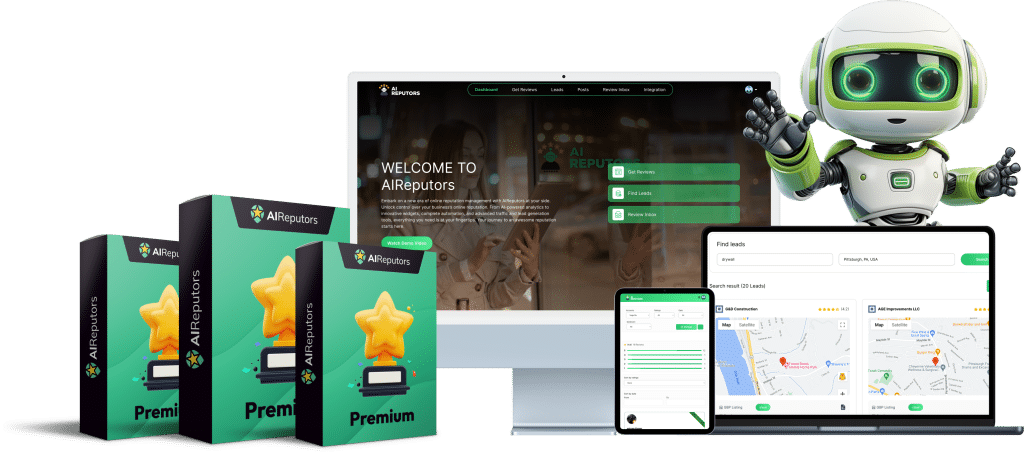
>> Bundel Deal Edition <<

Your Free Hot Bonuses Packages
>> Reseller Bonuses Packages 1<<
>> Reseller Bonuses Package 2 <<
>> Hot Bonuses Package 3<<
>> Hot Bonuses Package 4 <<
Find the AIReputors OTO links first and then proceed to the direct sales pages provided with the bundle. AIReputors OTO hot bonuses packages value $40k with a great discount and three sizzling bonus products will indeed take you on a trip to the world of automation and the changes it can have on various industries with a fast speed. Look at the AIReputors OTO sales pages with all the information for each OTOs down the bottom.
AIReputors OTO
Important: We suggest you take up the combo deal edition ” FE + All Upgrades version ” and save $315
==>Use this coupon to save $50 ” AIREPUTORS “
>> Bundel Deal Edition <<
>> Front-End <<
>> OTO1 ‘Fast Pass’ Edition <<
>> OTO2 Unlimited Edition <<
>> OTO3 Platinum Edition <<
>> OTO4 Enterprise Edition <<
>> OTO5 RankReel Special Edition <<
>> OTO6 Koincart Special Edition <<
>> OTO7 ClickagencyAI Special Edition <<
Your Free Hot Bonuses Packages
>> Reseller Bonuses Packages 1<<
>> Reseller Bonuses Package 2 <<
>> Hot Bonuses Package 3<<
>> Hot Bonuses Package 4 <<
Today, the rapid changes happening in the global market, including the increasing automation, are profoundly changing various industries like technology, and many others. The advantages of automation are numerous. This article will not only discuss them in some detail, but it will also cover the challenges involved. The article also reflects the author’s deep knowledge of the topic. From the production of goods and logistics to the field of health and medicine and business, automation has literally had an impact on the world’s business field in terms of the ways companies operate and their efficiency as well. (and also shows the potential of this technology) to the business field on a huge level of moving through the intensive automaton which is greatly more than just the manual workforce or doing more with less. It is also an attempt to give a picture of the distribution of technology capabilities across manufacturing, and this along with the reduction of labor force by simple automation would directly contribute to the increase of the working class. The coverage also includes a wide range of technologies from the
AIReputors OTO – Manufacturing Industry
improved Efficiency and Productivity
Automated systems and processes have undoubtedly transformed manufacturing. A noticeable increase in the efficiency and productivity of work was observed after the implementation of automation technology designed for handling various systems and processes. The time taken for the production of goods could be reduced by employing automation technology i.e., faster, error-free, and more reliable ways of process execution. Firstly, automation technology allows for a transition to fully automated assembly lines and the introduction of robotics, which will in turn lead to a speedier and more accurate upshot of the production process. Moreover, the introduction of automation leads to higher work efficiency. As a result, automation technology enables companies to boost their production output, handle customer orders in a more effective and efficient way and consequently improve their competitive advantage in the market.
Decrease in Production Costs
The cost of labor is one of the most important expenses that manufacturers can significantly reduce. One of the most important advantages of automation technology in the manufacturing industry is the decrease in labor costs. Automating manual labor offers the opportunity to reduce the number of people employed in a company, which is a very significant approach to the reduction of workforce costs. Automated systems could handle those repetitive and tedious jobs that do not require much brain activity by workers and thus, stem the requirement for a large workforce and provide the firm with a way of saving on labor costs. This will help the company reallocate resources more efficiently and invest in other areas of the business such as research and development or improving the product quality.
Better Work Environment
Automation technology has been the driving force for better work environment in the manufacturing industry due to the complete replacement of human beings by robotic and machinery in work that has potentially hazardous conditions. One of the major benefits of automation technology in the manufacturing industry is that it ensures safe working conditions. Let us start with the fact that all the dangerous and places environmentally unsafe for humans can be left for the machines to handle and thus, the human workers are safe as there is no possibility for physical harm or ill-health. It is worth noting that an automated work environment has proved to be of great significance ensuring workplace safety and preventing accidents as well.
Improved Precision and Accuracy
Utilizing automation technology, manufacturers can achieve a new level of precision and accuracy in the production process. Using machines and robots for carrying out jobs purely on a fastidious edge of errors completely eliminates the idea of human error, frequently encountered during the assembly or manufacturing phase. This is primarily important in the industries for which accuracy is an absolute requirement, such as the production of electronic components or medical devices. The automation technology for accurate measurements and uniform quality ensures that companies are able to provide customers with top-notch products, thus they become the very products striving to meet the highest quality standards and customer demand.
Control of Quality in a Better Way
Automation plays a very important role in quality control processes, which, of course, is true for the manufacturing industry too. The problem of faulty products is minimized by Automated systems that are able to perform very complicated and advanced quality checks that an ordinary person could not be able to perform, thus they are able to notice even the smallest defects or deviations from parameter setpoints ensuring the product maintained their best quality. Through the introduction of the processes of automatic inspection and testing, the manufacturers can quickly identify the defects and thus prevent the defective products from getting into the market. The changes in the level of the overall product satisfaction of the clients get aligned with the customer satisfaction from the products which are of the highest quality, and, therefore, the returns and recalls are minimized for the vending party.
AIReputors OTO – Transportation and Logistics Industry
Automated Vehicles and Drones
The transportation and logistics industry has experienced a major transition due to the utilization of automation technology and the subsequent invention of the automated vehicles and drones. The new mode of mobility has come with the success of using unmanned vehicles in the execution of delivery tasks. The new automated vehicles like self-driven cars, and trucks seem promising in revolutionizing the transport sector by minimizing the number of people needed for operations and increasing the efficiency of transport operations. Drones, on the other hand, have revolutionized delivery methods by carrying parcels and inventory of an extremely small distance. The use of automated vehicles and drones not only ensures fast and efficient transportation but also reduces the probability of human-caused accidents, thereby conferring these modes of transportation an additional advantage over traditional methods.
Efficient Supply Chain Management
Automation in technology has been a major facilitator of the development of supply chain management in the industry of transportation and logistics. For instance, now companies can use sophisticated software systems to optimize their supply chain management, thus lowering the costs and, at the same time, improving efficiency. The inventory status can be maintained in real-time by the implementation of automated systems, which will give the companies a chance to manage their stock more accurately and also to avoid overstocks and out-of-stocks. Further, automation fosters the cooperation and communication between stakeholders in the supply chain, which in turn leads to faster delivery time and reduced delay of goods.
Enhanced Tracking and Monitoring Systems
Automation technologies have had a groundbreaking impact on the tracking and monitoring systems of the transportation and logistics industry. If we talk about the use of advanced GPS and sensor technologies, then businesses can have an opportunity to track the location and condition of their assets, like trucks and goods, on a real-time basis. The GPS technology combined with the real-time tracking function would mean the company can see all the processes clearly and have them under control, therefore, the efficiency of the operations will cater for reducing theft or any other unlawful activities such as loss or damaged goods. Moreover, the automatic monitoring of the system would enable the system to detect the deviation at an early stage and send a signal to the company to take the necessary actions, thus potentially saving the situation.
Improved Delivery Speed
The advent of automation in technology has led to a substantial increase in the speed of delivery in the transportation and logistics industry. The utilization of automated systems by companies will bring about faster delivery processes that will in turn save time for material handling and transportation. For instance, the automated systems for sorting and loading in the warehouses not only allow quicker and more efficient truck loading but also minimize the chances of delays, which can lead to faster delivery of the whole. Furthermore, the implementation of automatic vehicles and drones ensures the direct daily use of faster and more convenient routes which have no stops and shorter times of traveling are lesser, as a result, a quicker delivery is possible.
Reduction in Human Error
The role of automation technology in the transportation and logistics industry has been instrumental in the reduction of human error. By replacing manual processes with automated systems, errors resulting from human factors, such as tiredness or distraction, can be efficiently mitigated. Automated systems are able to perform tasks with a greater level of accuracy and consistency, thus reducing errors in order processing, inventory management, and shipment tracking. As a result, there will be more satisfied customers, and the costs for error correction or rework will be reduced or even eliminated.
AIReputors OTO – Healthcare Industry
Robotic Surgery and Assistive Devices
Advances in technology intend to refine the healthcare industry by primarily focusing on the surgery department. To say the least, robotic surgery systems afford the possibility of performing operations with high precision and less intrusive nature, thus being less prone to complications and gaining better patient outcomes. The robots give the doctors an extra tool for carrying out the operations with precision and finesse, which is directly proportional to quicker recoveries and shorter hospital stays. Moreover, healthcare professionals have been able to design wearable robotic devices to aid people suffering from paralysis, called exoskeletons, and those who have lost limbs, called prosthetics, in walking along the path of physical recovery.
Automation of Administrative Tasks
One more advantage that comes with the use of automation technology in the healthcare industry is the effective and efficient streamlining of the administrative tasks, where it enhances operational efficiency and takes a load off of the healthcare workers. Automated systems are capable of carrying out tasks like scheduling appointments, patient registration, and billing, which nullify the chances of errors hence making it a very safe and fast method. So, health workers can now attend to patients’ needs at more flexible times and involve themselves less in the administrative tasks. Besides, through automation, health care institutions can share information about patients with other caregivers, and as a result, the care and the safety of the patient are better ensured.
Streamlined Patient Monitoring and Care
Automation technology is instrumental in improving patient monitoring and care in the healthcare industry. One of the most evident reasons is the automated monitoring systems that can non-stop monitor vital signs and inform health professionals about any changes or abnormalities in a patient’s condition. Consequently, the treatment of potential health issues at an initial stage is made possible and timely measures can be taken for implementing an improvement in patient outcomes and a reduction in the danger of developing complications. Moreover, new opportunities related to the Internet of Things, such as smart wearables and remote health monitoring systems, have been unfolded due to automation technology that allows patients to receive healthcare services in their homes while communicating with their healthcare providers in a timely manner.
Improved Accuracy in Diagnosis
One of the most important changes caused by automation technology in the healthcare industry is the increase in diagnostic accuracy. Emerging imaging technologies, like the automated radiology systems and AI-powered diagnostic algorithms, not only can filter and process medical images but also can find the signs of a certain disease with much more accuracy when compared to a human being alone. So, it is not only a question of doing mightily accurate diagnoses, but the matter boils down to the increased confidence and dependability of decision-making that are enabled by healthcare providers. Additionally, the automation technology makes it possible to process giant heaps of patient data which will be used as a basis for better understanding of the distribution of different diseases and the detection of their symptoms in the earlier stages.
Enhanced Drug Discovery and Research
AI and automation technology have led to significant advancements in drug discovery and research.osaur.com/whatisai-intro/dr chtoai/)Chemoinformatics has been one of the areas that greatly benefited from robots and AI in drug research. High throughput screening is a common term used in pharmaceutics that usually involves robots testing up to hundreds of thousands of chemical compounds. Tools like molecular modeling, which involve artificial intelligence and robotics, save time and money in the design and selection of the best drug.”>(Bio)-This technology has been used in the field of drug discovery for quite some time already. The development of novel compounds is the first part of it.’]=”;s/fact/cheleva/]Drugs have been discovered and developed with the help of robots and AI for years. A drug development cycle starts with the synthesis of new compounds of the desired activity using high throughput screening robots. It also introduces technologies such as molecular modeling that minimize time and costs during the phase of the drug design and resulting in a successful candidate drug. Such advancement had greatly influenced the way brands expanded their product line, like auto-initiated pregnancy tests, new brands of tampons with an added deodorant, chewing gums of new flavors and mintsThe change in the healthcare industry from the traditional way of drug discovery & research process to the present method, which is totally automated, is what it is called the Automation technology revolution. The high-throughput screening technologies and automated laboratory systems are the reason behind faster and more efficient testing of potential drug candidates. The drug development process speeds up with reduced time and costs involved in bringing new drugs to the market. The applications of automation technology have indeed brought a lot of advantages to disease mapping, as it enables the analysis of large-scale genomic and proteomic data and the reliable identification of potential therapeutic targets, resulting in a better understanding of diseases.
AIReputors OTO – Retail Industry
Automated Checkout Systems
The checkout efficiency and the customer experience at the retail sector are the two main things that have greatly impacted by automation technology. Such systems like the self-service kiosks or the mobile payment solutions take care of such applications whose customer takes less time to finish their purchases and the attitude of the clients soars because waiting times are reduced to a minimum and overall satisfaction is enhanced. Moreover, retailers can omit staff from the checkout while getting customer satisfaction who can allocate their human resources more effectively.
Inventory Management and Stocking
The retail industry has undergone extensive change in inventory management and storage operations, brought about by automation technology. Automation reduced all tough problems of retailing as retailers can rely on the number of goods present in different stock points and thus know when the stock is being overexposed or when there is no stock. The stocking system automatically refills stock, thereby simplifying the restocking process, and at the same time, the sales are increased and the problem of too many outdated or out-of-date products is mitigated. Generally, the reward that goes with the rationalization of consumer stock is that the retailer can be sure that products are readily available and the chances of a customer leaving with an empty hand are quite negligible.
Personalized Customer Experiences
The automated technology has made it possible for retailers to create and distribute personal customer experiences easily. Retailers, by using CRMs and data analytic tools, can collect and analyze their users’ data to create more effective marketing campaigns and product ranges. The automated systems can offer the right product according to the customer’s buying history and preferences. This strategy can improve the repurchase rate of the customer as well as enhance his/her loyalty. What’s more, the real benefit of automation technology is that it is not only the source of very focused marketing campaigns but also personalized promotional offers, which result in very satisfied customers and boost sales.
Efficient Supply Chain and Distribution
Automation technology has really turned things around in the retail industry by drastically improving the supply chain and distribution processes. Through integrating cutting-edge logistics and warehouse management systems, retailers can streamline their supply chain activities, which can lead to higher profit margins and faster and cheaper deliveries. The automated systems can trace the inventory chain so that retailers can locate the goods and allocate them efficiently. This will guarantee the on-time delivery of products to customers without the occurrence of shortages or overloading. Through its practical use, automation has also supported the coordination and communication among the entities in the supply chain, thereby contributing to the reduction of delays and the overall performance of the supply chain.
Improved Data Analysis for Customer Insights
The application of robots in the retail industry has gone a long way in making a lot of things easier compared to traditional means. Retailers can now process a lot of data using advanced analytical tools to gain insights into their customers, which include details of their buying patterns, preferences, and demographics. As a result, retailers have a better understanding of their customers’ taste and changing trends, which translates into the ability to focus more on customer needs and the design of products, their marketing campaign strategy, and pricing strategies. Not just that, it has also become real-time possible to monitor and analyze customer feedback and interactions on social media to get immediate feedback. Retailers can use this opportunity to respond to the customers’ complaints and quickly rectify any shortfalls.
AIReputors OTO – Banking and Finance Industry
Automatic Execution of Bank & Finance Operations
Through automation, banks and finance companies experience a powerful cut in their workloads. The combined internet and wireless banking platforms have completely transformed the access and delivery of various banking services to customers. Customers can now carry on different banking activities such as fund transfers, bill payments, or account balance inquiries without physically visiting the bank. It is much more convenient for them now and at the same time saves a lot of labor for the bank employees. Automated transaction processing systems greatly facilitate faster and error-free completion and as a result, there is no need for manual data input, and the risks of making errors are reduced to the minimum.
Optimized Loan and Mortgage Processes
Automation has particularly benefitted the loan and mortgage sectors of the banking industry by introducing new and improved processes. An automated loan origination system handles the whole process – application, credit scoring, decision-making- much more quickly, resulting in more loan approvals being granted and the time consumed for manual underwriting being reduced. This not only has a direct impact on customer satisfaction, but it also significantly boosts loan operations’ efficiency. Once customers’ identity and creditworthiness are verified, paper documents can be signed online which dispenses the need for the physical paperwork, thereby reducing errors or delays in the process.
Fraud Detection and Prevention
Automation technology is a vital element in the detection and prevention of fraudulent activities in the banking and financial industry. This technology uses cutting edge fraud detection systems that are equipped with machine learning algorithms and data analytics to carry out the real-time recognition and prevention of fraudulent activities. These new systems have the power to access huge amounts of transactional data and to spot any lurking suspicious patterns or anomalies, hence reacting with warnings or by blocking the transaction itself. By using a machine the process of fraud detection goes forward; financial institutions stand to either gain or lose a significant amount of money, and they can also protect their customers from any scams that might be in the bank.
Improved Risk Analysis
The automation technology has simply revolutionized the entire essence of risk analysis in the financial and banking sector. This advanced risk management system and models have brought changes in the manner with which financial institutions assess and manage various risks more effectively. Through this automated system, the risk analysis system can process and analyze the many sources of data like financial and economic indicators, market trends, customer behavior, etc., which will relatively quickly give the crucial information needed to take a decision like the possible risks and the estimation of them. These measures and the new system allow decision-makers at different levels to be proactive and to develop strategies that are less likely to contain financial risks or crisis situations.
Efficient Customer Service
Automation has indeed changed the whole significance of customer service in the banking and finance industry. With the adoption of chatbots, and virtual assistants, the 24/7 customer service problem is solved as banks and other financial institutions can offer round-the-clock services like answering the frequently repeating questions among others, assistance in inquiries about accounts, or providing basic financial advice. Doing this leads to increment in customer satisfaction as the customers get served instantly and the services are customer specific. This means that customer service representatives will be left with a lighter workload. Technically, when a customer’s information is centralized, it is easy for the relevant institution to be channeling products or services to the customer based on the customers’ needs and preferences. This is a privilege to the financial institutions in allowing the customers’ needs to be catered for effortlessly while the customers don’t get annoyed by receiving unwanted, irrelevant, and information that is not based on their preferences.
AIReputors OTO – Agricultural Industry
Automated Harvesting and Planting
The innovation of technology has made it possible to change the course of the agricultural industry in terms of the harvesting and planting process. With the help of the automated harvesting system, such as the robots for picking and the harvesters, we can get the tasks to be performed faster and at the same time be more efficient and we can compare this with the manual labor process. The result is a reduction in time and labor, which otherwise would have been used for the harvesting of crops. Automated planting, such as the precision seeders and transplanters, make it certain that there is an optimum plant distance and accurate seedling location, thus, making the yield of the crops better and the risk of crop failure less. Furthermore, the risk of crop failure is lessened by the reduced and the labors employed in the process.
Precision Agriculture and Soil Monitoring
Automation technology has caused a great revolution in the realm of agriculture in terms of precision agriculture and soil monitoring. Through modern sensors and data analytics, farmers get to collect and carry out a real-time analysis of the information on soil moisture levels, nutrient content, or pest infestation. Thus, farmers can thus optimize irrigation and fertilization practices, better plant growth, and, therefore, minimum input of resources. Also, the generated automated system’s suggestions or alerts give rise to analyzing the data to the benefit of the farmers, who in turn can take steps to cut pests and diseases in time.
Enhanced Crop Management
Automation technology has underlined a new round of crop management method in farming. With the aid of the automatized systems, the field of crop production can be managed by the farmers from a remote location. In this way, better management of resources is achieved, and the undesirable conditions of soil, air, and temperature are eliminated in the process of crop production, thus the probability of the failure of the plant goes down. However, the present technology can also generate crop health information and growth rates in real time, which will allow the producers to go the data way when it comes to issues such as harvesting, pest, and disease attenuation. This points to the fact that the crop’s quality will be much better, the quantity will increase, and the costs related to manual labor and resource use will be minimized.
Improved Livestock Monitoring and Care
Automation technology has made a major breakthrough in the monitoring and care of livestock in the agricultural industry enabling the use of advanced sensors and management systems for livestock. By means of modern technology, farmers now can monitor the health, the habits of feeding, or even the surrounding conditions of their animals from a distance. This not only leads to a timely discovery of animal diseases or behavioral changes but also then necessary actions are undertaken which reduces the risk of an outbreak or even the animals’ death. Furthermore, automated feeding and milking operations guarantee that the animals are given the best and most consistent food, offer better health and higher productivity.
Efficient Irrigation Systems
Automation technology is playing a very vital role as far as the irrigation systems are concerned in the agricultural industry. With the help of automatic irrigation systems, the focus of the farmers shifts to water conservation as it becomes achievable by applying an efficient amount of water at the specific time. Modern sensors and data analytics can provide the status of the soil water content as well asthe weather data to the farmers, and as a result, they can schedule their watering more accurately based on the actual requirements of the crops. This leads to a minimized loss of water resources and energy, an assured plant growth, and a good harvest. Furthermore, the use of automation technology for irrigation purposes means that these systems can be controlled and monitored from a distance thus reducing the need for manpower and hence reducing the cost of operation.
AIReputors OTO – Hospitality and Tourism Industry
Automated Check-in and Check-out Processes
Automation technology has simply changed the entire game of the check-in and check-out processes in the hospitality and tourism industry with the greater efficiency and ease. The usage of self-service kiosks or mobile apps now has made it possible for the guests to quickly and easily complete the check-in process, therefore a limited waiting time and also the need for interaction with hotel staff are ensured. All this results in a fantastic guest experience which will also improve the operational efficiency of the hotel. Also, automation technology provides for a contactless check-out, through which the guests can pay their bills and return room keys without standing in a queue or at the front desk’s reception.
Personalized Guest Services
It is now much easier for the hospitality and tourism industry to provide personalized guest services, thanks to automation technology. By applying CRM (customer relationship management) systems and data analytics, hotels can collect and evaluate customer data to fully understand their services and offerings. Automated systems are capable of providing personalized recommendations to guests based on their preferences or past transactions, therefore, guests get peerless, delightful experiences and the practice increases the customer satisfaction index. Furthermore, the technology allows hotels to establish the guests’ requirements in advance and gives an edge in giving them personalized amenities or room preferences that will surely make them feel unique and special.
Efficient Room Maintenance
Current technology has made great progress in the field of room maintenance in hotels and other hospitality industry establishments. By using computerized equipment, hotels may monitor room conditions like room temperature, humidity, and energy consumption from a remote location. The new monitoring technology not only warns the hotel about any problems, it also allows for zero-minute corrections if needed, which reduces the chances of customer complaints or dissatisfaction. In addition, automation technology is capable of predictive maintenance, which lets hotels identify maintenance requirements that can turn into major problems well in advance. This not only brings down the number of hours that rooms are out of order but also improves the overall satisfaction of guests.
Streamlined Reservation Systems
Reservation systems in the hospitality and tourism industry have been changed beyond recognition by automation technology. Hotels are now using more advanced software systems to make the reservation process a completely effortless affair, with guests being able to book their rooms via online platforms or mobile applications with the greatest ease. Reservation systems which are automated are responsible for real-time availability, room rates, and customer preferences management, making the reservation process accurate and efficient. This reduces customer dissatisfaction by almost instantly confirming the reservations and minimizes the chances of overbooking or double bookings. Not only that, but automation technology is also capable of being easily incorporated with other hotel systems such as billing or guest services thus increasing the overall efficiency of operations.
Enhanced Data Analytics for Customer Insights
Automation technology has indeed become a very powerful tool when it comes to the collection of data for customer insights in the tourism and hospitality industry. Thanks to this, hotels can make use of the modern data analysis tools to have insight into guest data such as booking patterns, preferences, or feedback and be able to develop valuable insights on customer behavior and preferences and thus, for the purpose of planning targeted marketing campaigns and personalized offers. Furthermore, the automation technology enables real-time monitoring and analysis of guest feedback and social media interactions and consequently, hotels get instant feedback and can react to any issues or concerns immediately. By doing this, customer satisfaction and loyalty are greatly improved.
AIReputors OTO – Education Industry
E-learning Platforms and Automated Grading
It is a fact that the education industry has been significantly changed by the automation technology, particularly the field of e-learning. The students through the e-learning platforms can download the topics, carry on classes or interactive speaking and writing activities that are additional and moreover, hand over duties online. This move is very effective in this pandemic that has seen humanity locked indoors for long. The automation technology also supports the creation of digital scenarios, the automated version of which is a great help in saving the teachers’ scarce time resources and at the same time, the students get the benefit of their work being assessed right away. There’s an added value for both the printing out process and for the student experience as well by creating the student learning with printouts of the computer-based lessons. (Lagoudaki)
Virtual Reality and Simulation-based Education
Automation technology has played a role in improving virtual reality (VR) and simulation-based education in the education industry. Using VR technologies, students are able to engage in realistic and interactive learning environments that help them gain hands-on experience and bring the understanding of complex concepts to the next level. Besides, using simulation-based education, students can not only practice but also refine their knowledge in a safe and controlled environment, thereby not causing the occurrence of errors or accidents. As a result, this leads to an increase in learning outcomes and the absorption of knowledge in a better way than before.
Personalized Learning Experiences
Automation technology has been instrumental in helping companies create personalized learning experiences in the education industry. Learning management systems, and adaptive learning algorithms have been used to empower educators to customize education materials and practices to individual students. The automated systems can create tailored learning paths, recommending the best materials or activities based on the student’s performance and progress. This allows the students to understand the information at their speed and in a way that suits their learning preferences, which in turn leads to better engagement and knowledge retention.
Efficient Administrative Tasks
Automation technology has been the major driver of the shift to automated administrative tasks, which has led to an improvement in operational capabilities and also has seen a decrease in the workload of the educators in the education industry. Through the implementation of automated systems, educational institutions can manage student records, course registration, and scheduling processes much more accurately and time-efficiently. This will also mean that manual data entry and paperwork are less in demand and that teachers are more involved in activities that are related to teaching and student engagement. Furthermore, automation technology also facilitates better communication and cooperation among educators, learners, and parents, thus greatly improving the overall administrative processes and creating a more cohesive learning community.
Improved Data Analysis for Student Performance
Automation technology has transformed data analysis for student performance in the education industry. By utilizing modern analytics tools, educators can study vast volumes of student data, which cover assessments, attendance, or participation records. This in turn, a great understanding of the student’s performance will be achieved, making targeted interventions and support personalization possible. Moreover, by the use of automation technology, real-time monitoring of student progress is also possible and it detects areas where students are doing well and need help. Thus, this results in student success and empowers educators to choose instructional strategies or adjust the curriculum based on data.
AIReputors OTO – Construction Industry
Automated Building Systems
The technology of automation focuses on building systems in the construction industry. Here, automated systems are utilized through which we can control and monitor major building functions such as lighting, heating, ventilation, or security automatically. In so doing, we save energy, reduce the costs of operations, and ensure the best occupant’s comfort and safety of the building. In addition to this, the automation technology provides that building systems are monitored and controlled from distant places, and it to be done in real-time hence, no loss, and efficient rectifications.
Robotics in Construction Processes
Automated systems have been recently created to revolutionize construction processes through the integration of robotics. For example, robotic technology can perform various difficult and laborious tasks with great speed and precision, which would not be possible if human labor was applied. This also includes the part of self-driving vehicles that can play a role in the activities of construction such as excavation to transfer heavyweight, hence there are minimal chances of manual labor accidents, and in fact, the job is better done. Furthermore, 3D printing being done by robots is advantageous to construction since less time and money are used, and the designs can be adjusted more easily.
Efficient Project Planning and Management
Automation technology has been a huge help in efficient project planning and management in the construction industry. The leverage of cutting-edge project management software and automated scheduling systems, the utilizing of construction companies can make their project planning a lot more systematic and also assure the smooth existence and the resource allotment. The system of seller generation can monitor detailed project schedules, monitor real-time progress and be promptly informed about project lags and/or interferences. All of the above have a positive effect on the general project execution, thus, the risk of cost overruns or schedule delays is reduced, and at the same time, even more stakeholders collaborate on the project.
Improved Safety Measures
Automation technology is a major factor in the construction industry’s safety refinement. The fancy word of today, Internet of Things (IoT) technology, or as referred to in another way – the use of advanced safety systems along with IoT sensors, helps construction sites in the monitoring and management of safety aspects, such as worker location, condition of the place, or equipment operation. The described system of constant tracking should prevent the negative consequences of safety breaking situations by offering the possibility of prompt action and a reduction in the number of accidents. What’s more, the safety standards of work can be enforced via automation technology and the safety practices can be integrated into construction processes not only to guarantee compliance but also to enhance workplace safety as a whole.
Reduced Construction Time and Costs
Automation technology has led to a notable reduction in construction time and costs in the construction industry. The innovative use of automatic systems and processes in any construction project will not only make the operations more efficient as a whole however, decrease the amount of waste, and hence save a lot of time. For example, methods like pre-fabrication and modular construction are now facilitated and made faster by automation technology, thus, they help to minimize the assembly and installation time of building components that traditionally happened on construction sites. Furthermore, automation can also provide more accurate cost estimation, thereby keeping the budget in check and affording the project manager the opportunity to take corrective actions whenever necessary without running out of funds.
AIReputors OTO – Energy Industry
Automated Power Grid Management
Machine Learning has changed the whole picture of how power grid management is handled in the energy industry. Through the aid of advanced control systems and sensors, grid operators can be able to both observe and take care of their power grid system in real-time. Automatic systems that are deployed can also be flexible enough to perform the functions of recognizing the fluctuation in power demand, modifying the power generation and distribution process, and curtailing the risk brought about by a blackout or power disturbances. This high-level technology is, in fact, capable of creating a system where renewable energy is readily available in the grid, thus, generating power efficiently and in a green and sustainable manner.
Renewable Energy Systems
It is indeed true that automation technology has created an environment for the growth and utilization of the renewable energy sector in the energy industry. Through the incorporation of modern sensors, control systems, and smart grids, renewable energy sources like solar or wind power, can be intelligently integrated into the energy network. Automated systems that work on the side of renewable energy will be able to manage and control their production effectively, ensuring that the electricity is produced at the peak of performance and reducing the impact of weather changes. Also, this revolution in energy technology which is the automation of energy, accelerates the storage and distribution of renewable energy, therefore, neutralizing the issue of these renewables.
Efficient Energy Consumption Monitoring
Automation technology has changed the whole energy consumption monitoring of energy no other than the energy market itself. Energy providers and consumers jointly with the use of advanced metering and monitoring systems can basically monitor and analyze electricity usage behavior at the moment it occurs. Such information will help them figure out the users’ side and the demand side of the energy and as a result, the energy system will be managed effectively and costs will be lower. Moreover, such the same technology that we are talking about enables us to optimize the data of energy consumption as well as renewable energy systems and devices in a smart manner. Thereby, it brings forth much better energy management and distribution and also it provides the efficient maintenance of the energy needs throughout a particular period.
Improved Maintenance and Repair
Automation technology has significantly revolutionized maintenance and repair processes in the energy industry. Early detection of equipment failures or malfunctions is achieved through predictive maintenance systems and real-time monitoring, a situation where energy providers can take immediate action. When the equipment or the components are in good condition, for example, no insulation resistance limitations exist, then it is easy to improve defective devices, thus minimizing downtime and keeping the maintenance costs reduced. Furthermore, automation technology eases remote monitoring and diagnostics, hence the maintenance and repair become easier because they are conducted efficiently and safely through the remote access feature.
Enhanced Safety in Energy Production
Today, the use of automation technology has revolutionized safety measures that the energy production sector has adopted. Automation technology has significantly replaced manual work in the industry in activities that require the hiring of workers for risky workplaces. By integrating robots and automated systems, tasks that expose workers to dangerous locations or hazardous materials are relieved and they can be performed safely by them, thus the accident risks are greatly reduced. It also allows for real-time monitoring of safety parameters such as temperature or pressure, which leads to immediate alerts and prompt action to prevent a bad situation or system failure. The latter benefits the industry by raising the safety standards and implementing risk management practices.
To sum up, technology has by no doubt, resulted in the improvement of multiple industries by the improvement of productivity, the enhancement of customer experiences, and the increase in efficiency and safety standards. The benefits of automation have been enjoyed by sectors like healthcare and education, which in turn have streamlined their operations, and can currently achieve excellent results with the minimum costs to the benefit of the users. The faster the enterprises accept and adopt automation, the more the room for growth and innovation, hence leading to the future that is more sustainable and prosperous across numerous sectors.
Table of Contents