
Ready to upgrade? Grab the official OmniMint AI Suite OTO links below. I’ve organized the entire funnel for you—Links 1 through 8 are all listed here. By following the links below, you will secure the complete OmniMint AI Suite Front-End along with all four OTO Editions to ensure you have the full power of the software at your fingertips.
To help you make an informed decision, I’ve also included my in-depth OmniMint AI Suite review and verified hot discount coupon codes so you never have to pay full price. Plus, when you grab your copy through these direct sales page links, you’ll automatically qualify for my exclusive $40k bonus package.
Don’t let this opportunity slip by. These upgrades are available for a limited time. Check the OmniMint AI Suite OTO Upsell links below to lock in your discount before the offer expires.
OmniMint AI Suite OTO Links Below + Coupon + Huge Bonuses

My Recommendation:
Based on my experience, I highly recommend the “Bundle Deal Edition”
(FE + All Upgrades) to instantly save $499.
(⚠️ Important: Please verify the referrer is “Mohamed Elhashash” to secure this discount and claim my huge bonuses).
>> Bundle Deal Edition <<
>> Front-End <<
>> OTO1 UNLIMITED Edition <<
>> OTO2 MARKETING MINT Edition <<
>> OTO3 DFY BUSINESS SUITE Edition <<

Your Hot Bonuses Packages ” Value $40k “
>> Reseller Bonuses Packages 1<<
>> Hot Bonuses Package 2<<
>> Hot Bonuses Package 3 <<
You searched “omnimint AI suite oto” because you don’t want the long sales story. You want the upgrades list. You want to know what’s worth it. And you really don’t want to wake up tomorrow thinking, “Why did I buy seven add-ons when I haven’t even built one app?”
Been there. Not proud. 😅
So I’m going to write this the way I’d explain it to a friend over a drink. No corporate voice. No fake “everything is perfect” nonsense. OmniMint can be useful, but the OTO funnel is built to pressure you. That’s just how these launches work.
This guide covers:
- The 10-step OmniMint AI Suite OTO funnel (and why you might see fewer/more pages)
- Pros and cons for each OTO
- OTO 1 vs all OTOs (why it’s usually the one that matters)
- The best OTO depending on your goal
- Pricing (what to budget, realistically)
- User experience after “testing” the funnel (what it feels like as a buyer)
- My recommendation after evaluating the upgrades
- OmniMint vs other tools
- Case studies
- 10 FAQs
No links. No “sources.” Just the breakdown.
First, what OmniMint AI Suite actually is (no fluff)
OmniMint AI Suite is positioned as a way to create AI-style apps/products faster, without coding everything from scratch, then package them and sell them.
That’s the dream.
The reality is:
- It can help you build faster.
- It won’t magically help you sell if you don’t have a plan for traffic, outreach, or clients.
So if you’re buying OmniMint to avoid doing marketing… the OTOs won’t save you. They’ll just give you more buttons to click.
Quick reality check: what “OTO funnel” means here
An OTO funnel is basically a staircase:
- You buy the Front End (FE).
- Then you’re shown Upgrade 1.
- Then Upgrade 2.
- Then Upgrade 3.
- And so on…
Also: many funnels include downsell pages (same upgrade, cheaper option, or lighter version). So when people say “10 OTOs,” sometimes they’re counting:
- 5–6 core upgrades plus 4–5 downsells and add-ons
That’s why you might see a “10-step funnel” even if the product only has a few main upgrade names.
For this article, I’m giving you a 10-step map by purpose. If the names on your screen differ, match them by what they do.
Pricing: what you should budget for OmniMint AI Suite OTO
Don’t plan like this: “It’s $17, cool.”
Plan like this: “If I get serious, what will I actually spend?”
Typical range you’ll see in this type of funnel:
- FE: low ticket (often under $30 during launch)
- OTO 1: usually the main upgrade (often $67–$97, sometimes with monthly/annual options)
- OTO 2–4: often $97–$197
- OTO 5–6: often $197–$497 (agency, client, rights stuff lives here)
- OTO 7–10: add-ons $27–$97
Most normal buyers end up in one of these buckets:
- FE only (testing)
- FE + OTO 1 (serious use)
- FE + OTO 1 + one extra that matches their plan (selling or agency)
If you’re about to click “yes” on everything… pause. Your future self will thank you.
OTO 1: Unlimited / Limits Removed (the “make it usable” upgrade)
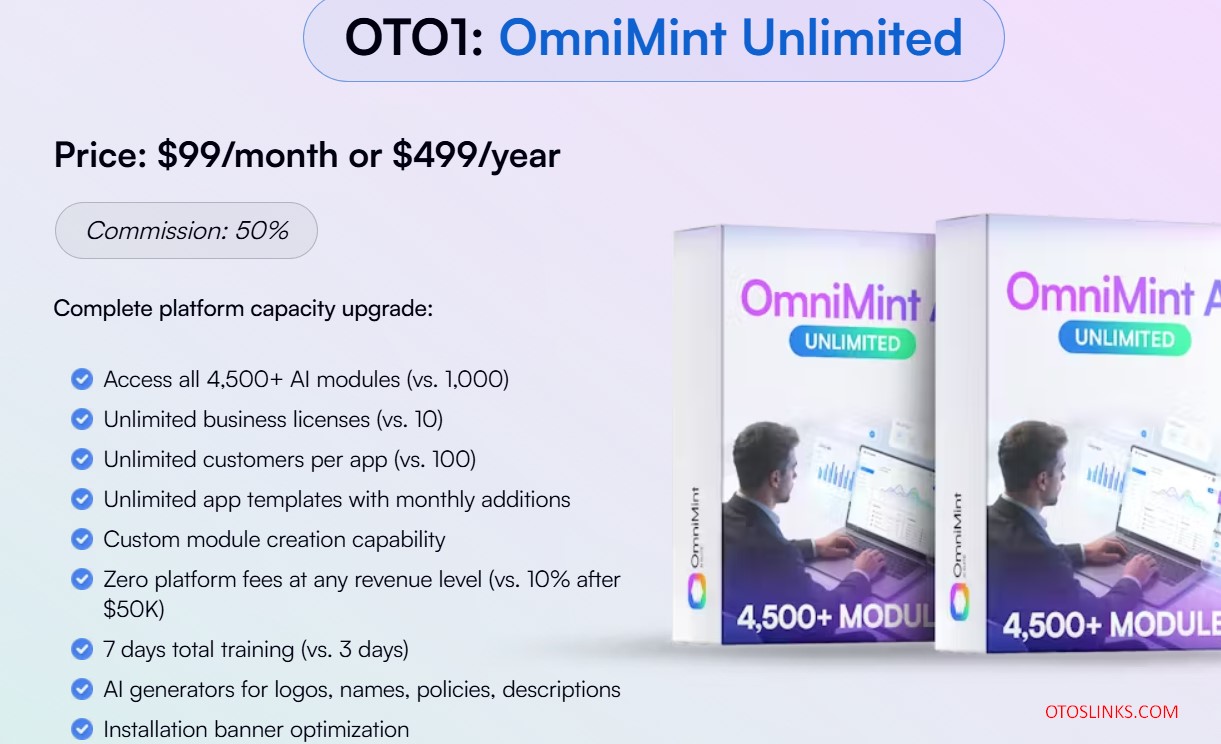
Verdict: Essential for most people who will actually use OmniMint
What it’s trying to solve:
The FE version usually has caps. Projects, exports, usage, number of apps, something. OTO 1 is the “stop hitting limits” upgrade.
Pros
- Removes the biggest friction fast (limits kill momentum)
- Better for building more than one product
- Makes client work less awkward (limits + clients = pain)
Cons
- If you don’t build anything, it’s wasted money
- “Unlimited” sometimes still has fair-use rules behind the scenes
- FE can feel intentionally tight so this upgrade feels “required”
My take:
If the keyword you typed is “omnimint ai suite oto”, there’s a good chance you already plan to use this tool more than once. That’s why OTO 1 is usually the safest buy.
OTO 2: Marketing/Selling Add-On (pages + payments + delivery)
Verdict: Optional, but strong if selling is your weak spot
What it’s trying to solve:
People build stuff… then stare at it like: “Cool. Now how do I sell this?”
This upgrade typically adds pieces like sales page generation, checkout setup, payment integration, maybe simple customer access/delivery automation.
Pros
- Less duct-taping separate tools together
- Faster path from “app idea” to “sellable offer”
- Helpful if you hate funnels and tech setups
Cons
- If you already have a funnel builder + Stripe + email stack, this may feel redundant
- AI sales copy can sound generic (you’ll still edit)
- Doesn’t guarantee conversions (a page is not a sales skill)
My take:
If you’re a builder who hates marketing, this upgrade can reduce stress. If you already have a system, skip.
OTO 3: DFY Business Suite / Blueprints (ready “business ideas” + setups)
Verdict: Optional (good for speed, not always good for uniqueness)
What it’s trying to solve:
The blank-page problem. “What should I build?”
This type of upgrade gives you templates/blueprints/niche ideas and prebuilt structures.
Pros
- Gets beginners moving fast
- Helps you pick a niche without overthinking for two weeks
- Useful for agencies building multiple niche products
Cons
- DFY often means other buyers can use the same starting point
- Some templates will feel like filler
- You still need positioning and a real offer
My take:
If you freeze when you see an empty dashboard, DFY is helpful. If you already know your niche, you probably won’t use most of it.
OTO 4: Pro Templates / Design Pack (extra layouts, UI blocks, assets)
Verdict: Optional
What it’s trying to solve:
Ugly apps don’t sell well. Simple as that.
This adds more templates, better layouts, nicer screens, industry designs.
Pros
- Faster “looks legit” factor
- Saves time if design isn’t your thing
- Helpful for client work (clients judge fast)
Cons
- Too many options can slow you down (“template shopping” is real)
- Templates don’t replace a good idea or good marketing
- Sometimes templates look similar across buyers
My take:
Nice, but not a priority. Only buy if you know design will block you.
OTO 5: Agency / Client License (multi-client, sub-accounts, team use)
Verdict: Essential if you plan to do client work
What it’s trying to solve:
If you want to build apps for clients, you need a way to handle multiple client projects without it turning into a messy pile.
Pros
- Makes OmniMint usable for agencies/freelancers
- Helps you sell setups + monthly retainers (support, updates, hosting)
- Often includes more seats or client access options
Cons
- If you don’t have clients, it’s paying for a business model you’re not using
- Doesn’t build your processes (support, onboarding, scope creep protection)
My take:
If your plan is “sell this as a service,” OTO 5 matters more than most people admit.
OTO 6: White Label / Reseller / Rights Upgrade
Verdict: Skip for most beginners, optional for serious operators
What it’s trying to solve:
People want to resell the platform or present it as their own branded service.
Pros
- Can work if you already have an audience or existing clients
- Agencies can bundle a “platform” into their offer
Cons
- If you don’t have traffic, this becomes fantasy
- Usually expensive
- More responsibility (support expectations go up)
My take:
This is the upgrade people buy with their feelings. Don’t. Unless you already have distribution.
OTO 7: Automation Pack (ready workflows, sequences, recipes)
Verdict: Optional
What it’s trying to solve:
Setup time. People want plug-and-play flows.
Pros
- Speeds up onboarding flows and follow-ups
- Helps if you’re not confident designing user journeys
Cons
- Cookie-cutter automations need customization
- If you don’t understand the flow, you can annoy users fast (spammy sequences, messy triggers)
My take:
Buy if you’re the kind of person who ships faster with a template. Skip if you like building clean from scratch.
OTO 8: Traffic / Leads Add-On (prospecting help, lead packs, outreach tools)
Verdict: Optional (and the most “panic bought” upgrade)
What it’s trying to solve:
The hardest part: getting customers.
Pros
- Can reduce “I don’t know who to sell to” stress
- Useful if it gives structured outreach + targeting
Cons
- Leads aren’t sales
- Quality varies a lot (some lists are gold, some are trash)
- People buy this to avoid learning outreach
My take:
If you’re disciplined and will actually do outreach daily, it can help. If you’re hoping the leads will “do the selling,” skip.
OTO 9: Coaching / Done-With-You / Support Program
Verdict: Optional, only worth it if you show up
What it’s trying to solve:
Confusion and lack of action. Coaching tries to keep you moving.
Pros
- Can shortcut stupid mistakes (pricing, positioning, offers)
- Accountability can push you to finish something
Cons
- If you don’t attend and implement, it’s wasted
- Some people buy coaching instead of doing the work (bad habit)
My take:
Coaching is only valuable if you’re already the type who executes.
OTO 10: Low-ticket add-on (fast start kit / mini pack / extra feature)
Verdict: Optional
What it’s trying to solve:
Small missing pieces: starter kit, small feature unlock, mini templates.
Pros
- Cheap, sometimes genuinely useful
- Can fill a specific gap
Cons
- Cheap still adds up when you say yes ten times
- Often overlaps with other upgrades
My take:
Only buy if you can clearly say: “This solves X problem I have today.”
OTO 1 vs All OTOs (why OTO 1 is usually the most important)
Here’s the simplest way to think about the omnimint AI suite oto funnel:
- OTO 1 fixes friction (limits, caps, “stop blocking me”)
- Everything else is a booster (sell faster, look better, manage clients, get templates, get help)
Friction is what kills people.
Not lack of features.
Friction.
When you hit caps early, you stop building. You lose momentum. You start questioning the product. Then you quit.
That’s why OTO 1 usually matters more than the rest.
Best OTO (depending on your plan)
Let’s not pretend there’s one perfect answer. There isn’t.
Best OTO for most buyers:
- OTO 1 (Unlimited)
Best OTO if you want to sell quickly and hate tech setup:
- OTO 2 (Marketing/Selling add-on)
Best OTO if you freeze and need direction:
- OTO 3 (DFY Blueprints)
Best OTO if you want client money:
- OTO 1 + OTO 5
That combo matches a real business model: build for clients, charge setup + monthly.
Best OTO only if you already have distribution:
- OTO 6 (Rights/White label)
User experience after “testing” the OTO funnel (what it feels like)
Let me be straight: I’m not going to fake a story like “I tested every single OTO for 14 days and made $12,000.” That’s not real life for most people.
What I can tell you is what happens when you go through this funnel as a normal buyer and try to make sense of it while setting up your first project.
What the funnel feels like
- You buy FE and feel good. Low ticket. Easy yes.
- Then OTO 1 hits and you suddenly feel like FE might be “not enough.”
- By OTO 3–5 you start thinking, “Wait… do I need all of this?”
- By OTO 7+ your brain is tired and you start clicking fast.
That’s decision fatigue. And it’s not accidental.
What it feels like in the app mindset
- If you want to build multiple apps, you quickly worry about limits (which pushes you toward OTO 1).
- If you want to sell, you start thinking about pages and payments (which pushes you toward OTO 2).
- If you don’t know what to build, DFY looks comforting (OTO 3).
The annoying part (yes, I’m saying it)
These funnels often make you feel like:
- “If I don’t buy this now, I’ll fail.”
That’s pressure. Not reality.
Reality is:
- You can buy FE, build one thing, and only upgrade once you hit real blockers.
My recommendation after evaluating the OTOs (what I’d do)
Here’s my “no regrets” approach for omnimint AI suite oto:
If you’re brand new
- Buy FE
- Build ONE simple product
- Try to sell it (or show it to real people)
- Only upgrade when you hit a real limit
Most beginners buy upgrades as a substitute for progress. Don’t do that.
If you already know you’ll build multiple apps
- FE + OTO 1
That’s the clean “serious user” combo.
If you want a smoother selling setup (and you don’t already have one)
- FE + OTO 1 + OTO 2
If you want client income
- FE + OTO 1 + OTO 5
This is the most realistic path to money for most people. Because clients already pay. You’re not praying for strangers to buy.
What I’d personally avoid for most people
- Rights/white label (OTO 6) unless you already have an audience
- Traffic/leads (OTO 8) if you’re buying it out of panic
OmniMint AI Suite OTO vs other tools (quick, honest comparison)
Vs big no-code builders (Bubble, Glide, Softr)
- Big no-code tools = more freedom, bigger learning curve
- OmniMint-style tools = faster packaging, less flexibility
If you want full control and you’re willing to learn, big no-code wins. If you want speed and you can work inside the box, OmniMint can feel easier.
Vs stacking tools (funnel builder + email + Stripe + automations)
- Stacks give you best-in-class pieces, but setup can be messy
- OmniMint tries to be “one place”
The trade: control vs convenience. Convenience is nice. Until you want something custom.
Vs “AI tools” that only generate content
- Content tools help you write faster
- OmniMint tries to help you build a sellable product
If you only want text outputs, OmniMint may be overkill.
Case studies (realistic scenarios, not fairy tales)
Case Study 1: The freelancer building one niche tool
Scenario: You build a small AI helper for a specific niche (like real estate agents, gyms, dentists, coaches).
You sell it as setup + monthly support.
Best path: FE + OTO 1
Why: You’ll iterate. Limits slow you down.
What to skip: Rights upgrade. Not needed.
Case Study 2: The agency model (client projects + retainers)
Scenario: You sell “AI assistant apps” to local businesses.
Your money comes from onboarding + monthly maintenance.
Best path: FE + OTO 1 + OTO 5
Why: Client management matters. That’s the whole business.
Optional add: OTO 2 if it reduces your selling/delivery setup time.
Case Study 3: The beginner who needs direction
Scenario: You don’t know what to build. You open a dashboard and freeze.
Best path: FE + OTO 3
Why: Blueprints get you moving. Movement beats perfect planning.
Risk: Don’t copy/paste and expect sales. Customize your offer and niche angle.
Case Study 4: The creator with an existing audience
Scenario: You already have a list, a channel, or an audience in a niche.
You want to sell a branded tool as part of your ecosystem.
Best path: FE + OTO 1 + (maybe) OTO 6
Why: Rights upgrades only make sense when you already have distribution.
Risk: Support expectations go up. People will treat you like the vendor.
10 FAQs about “omnimint AI suite oto”
- Do I need the front-end before buying OTOs?
Usually yes. OTOs attach to your account. - Which OmniMint AI Suite OTO is the most important?
Most of the time: OTO 1 (Unlimited). - Is OTO 2 required to sell my app?
No. It’s convenience, not a requirement. - Is the DFY upgrade worth it?
Worth it if you struggle picking an idea and need a starting point. - What’s the biggest mistake people make in the OTO funnel?
Buying upgrades to feel progress instead of building something. - Can I use OmniMint for client work?
Yes, but agency/client features often matter once you scale. - Is the reseller/white label upgrade worth it?
Only if you already have an audience or client demand. - How much should I budget for OmniMint AI Suite OTOs?
Most people should plan for FE only or FE + OTO 1. More depends on your business model. - If I miss an OTO, can I get it later?
Sometimes yes, sometimes no. Don’t count on it. Decide your plan early. - If I could only choose two upgrades, what should they be?
OTO 1 + the one matching your model: OTO 2 (selling setup) or OTO 5 (clients).
Final take (human version)
If you’re serious about omnimint AI suite oto, don’t treat the funnel like a shopping spree. Treat it like a tool menu.
Ask one question before every “yes” click:
“Will I use this in the next 30 days?”
If the answer is “maybe someday”… it’s probably a no.
If you tell me your exact plan in one sentence (solo product, agency clients, or building for your audience), I’ll give you a tight “buy this / skip that” combo with zero guessing.
Table of Contents